
Evaluating the patient safety impacts of virtual wards for older people with frailty and acute care needs
Contact:
Prof Caroline Sanders (principal investigator)
caroline.sanders@manchester.ac.uk
Dr Kelly Howells
kelly.howells@manchester.ac.uk
Research theme
Developing safer health and care systems
What are virtual wards?
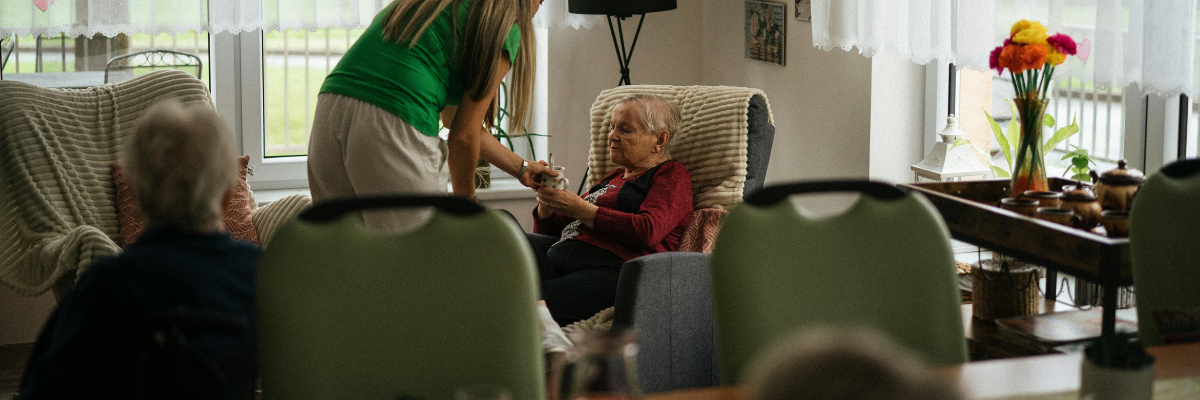
Virtual wards are time‑limited healthcare services that allow patients to be looked after and monitored at home rather than in hospital. When urgent care is needed for older people with acute care needs, virtual wards offer remote, hospital‑level care at home, without exposing the patient to additional risks.
As described by NHS England, “Virtual wards (also known as hospital at home) allow patients to get the care they need at home safely and conveniently, rather than being in hospital.”
A patient might be offered the choice of a virtual ward rather than being admitted to hospital, or they might be discharged early from hospital onto a virtual ward.
NHS Integrated Care Systems have been funded to extend virtual ward provision, and the NHS is increasingly implementing virtual wards to support people in the place they call home, including care homes.
Across the Greater Manchester (GM) region, Virtual wards are being used for conditions such as respiratory infections and frailty.
Respiratory infections, such as a cold or flu, can affect how people breathe and often affect the nose throat or lungs
Frailty is a term often used in medicine to refer to older people who are most at risk of problems such as falls and disability
What are we doing?
Our project is evaluating the patient safety impacts of virtual wards for older people with frailty and acute care needs, focusing on four different sites in the Greater Manchester region.
One of the research focuses of the NIHR Greater Manchester PSRC, covered by our Developing Safer Health and Care Systems theme, is to understand and improve how health and care services are delivered so that systems become safer for all patients, especially underserved groups. Therefore, we are investigating how virtual wards are actually working and exploring whether there are any differences in experiences and patient safety impacts associated with varied models of service delivery for people with frailty.
To find out about views and experiences, we are conducting interviews with patients, their carers, and healthcare workers who work on virtual wards. We are also talking to people who have been offered a virtual ward but who refused, and observing patients, their carers and virtual ward staff to understand how the new system is working and how any technology or equipment is being used.
This study will generate new evidence about ways of improving safety in the context of virtual wards for people with frailty. It will also produce insights and guidance to support patient safety within the context of virtual wards and help reduce patient safety inequalities.
Public and Community Involvement and Engagement
We want to ensure we include a diverse range of patients and carers, including ethnic minority communities and people experiencing poverty or poor housing.
The Virtual Wards evaluation was developed and is supported by ongoing public involvement work. The research team have collaborated with the ARC-GM PCIE Theme and the NIHR Applied Research Collaboration Greater Manchester (ARC-GM) to do this, including members of the ARC-GM PCIE Panel and wider community groups.
At the start of the project, public members were consulted on what the broad areas of focus should be. Over the course of the project, materials were developed which summarise the perspectives of several groups on Virtual Wards.
Who we are working with:
- Health Innovation Manchester
- The Greater Manchester Integrated Care Partnership
- NIHR Applied Research Collaboration Greater Manchester (ARC-GM)
- The Greater Manchester Virtual Ward Programme Board
Project outputs
Community Conversations: Virtual Wards and Hospital at Home discussion groups
To understand the real‑world impact of this model of care, we needed to hear directly from the people and communities who might use it. Therefore, to explore how virtual wards are being understood and experienced across the Greater Manchester region, we engaged with four distinct community groups to explore their thoughts and experiences around virtual wards and hospital-at-home care:
- Polish-speaking older adults
- Older members of the Chinese community
- South Asian women of mixed ages,
- A walking football older men’s group (predominantly white British)
Each discussion provided deep insight into cultural beliefs, healthcare expectations, and the challenges of implementing new models of care in different communities. We worked in collaboration with community connectors to plan recruit facilitate and organise appropriate translation and refreshments for the discussion groups.
With Made By Mortals, a creative arts organisation, we coproduced an interactive approach to the discussion utilising the participatory arts approach. The results can be explored in this blog, which focuses on the Patient and Community Involvement and Engagement outputs of this research project. Further findings, publications and additional outputs from the study will be available soon.
Behind the screen
Exploring virtual wards through diverse perspectives



The University of Manchester
Oxford Rd
Manchester
M13 9PL
UK
Site hosted by The University of Manchester.