
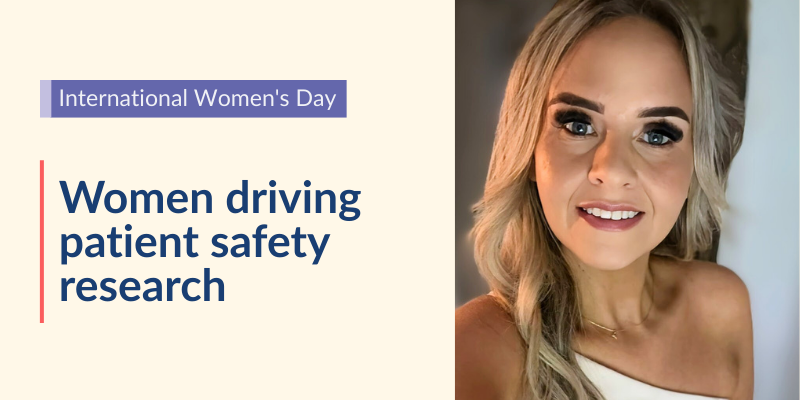
Women Driving Patient Safety Research: Meet Natasha Tyler
On International Women’s Day 2026, we are celebrating the women who are driving innovation and shaping the future of patient safety research across our team. Their expertise, leadership, and lived experience are helping to transform how we understand risk, deliver safer care, and ensure that patient voices are meaningfully embedded in research.
We are delighted to spotlight one of our research fellows, Dr Natasha Tyler, working on research on patient safety, mental health and care transitions, with a strong emphasis on improving healthcare systems and outcomes through evidence-based interventions and stakeholder involvement.
Read more about Natasha below.

Meet Natasha Tyler
Research Fellow in the Division of Population Health, Health Services Research & Primary Care at the University of Manchester
1 – Tell us a bit about yourself and your research background.
I’m a Research Fellow in the Division of Population Health, Health Services Research & Primary Care at the University of Manchester. My work focuses on patient safety in care transitions, particularly in mental health, where breakdowns in communication and coordination can undermine safe discharge and recovery. I’ve led and contributed to studies ranging from qualitative co‑design to systematic reviews and meta‑analyses. Most of my work involves working with multiple stakeholders to collect data or co-design interventions. Recent and current projects include developing and testing the SAFER‑MH/SAFER‑Dem/SAFER-YMH discharge care bundles, exploring medicines safety after mental‑health discharge, and evaluating transitional care interventions that reduce healthcare use and improve outcomes.
2 – What inspires you in your role, and who has influenced your journey in research or healthcare?
I’m inspired by patients, carers and frontline staff who tell us, often very candidly, what does and doesn’t work at points of transition. Their experiences motivate the kind of co‑production I try to embed in all of my projects. I’ve also been influenced by colleagues in Manchester’s patient‑safety community who push for evidence‑based, implementable solutions. Working alongside teams in the NIHR Greater Manchester Patient Safety Research Collaboration (GM PSRC) and collaborators in pharmacy and primary care has reinforced a systems view of safety, spanning medication, communication, and the emotional readiness for discharge. In terms of women in research, my biggest inspiration is my line manager Prof Maria Panagioti, she is the hardest working person I’ve ever met and makes complex decisions seem easy. She is incredibly supportive and constantly helps elevate and support junior team members, she is an inspiration for women in patient safety research.
3 – What are you currently working on and how does your work contribute to improving patient safety?
Right now, I’m finishing my NIHR Three Schools Mental Health Fellowship, looking at enhancing the SAFER-MH discharge intervention, however next month I’m moving back to the NIHR GM PSRC to study an app to reduce self-harm in young people discharged from mental health hospitals. The aim of almost all projects I am/was working on is practical: make discharge safer by structuring conversations, ensuring people understand their plan and medicines, and supporting staff to deliver consistent, person‑centred care. Alongside our qualitative and co‑design work, I contribute to evidence syntheses, that map what actually reduces readmissions and improves outcomes, so we can align service changes with the strongest evidence. Bringing these strands together helps translate research into tools and workflows that clinical teams can use.
4 – From your experience, what strengths or perspectives do women bring to patient‑safety research that enhance its quality or relevance?
In my experience, women in patient‑safety research often champion inclusive, relationship‑centred approaches, prioritising lived experience, psychological safety for staff, and the practicalities of everyday work. That perspective can shift projects from “what works in theory” to “what will work here, with these people, under real constraints.” I see this in co‑design sessions (where creating space for carers’ and patients’ voices changes the intervention) and in team cultures that support psychological safety which is vital when discussing error, risk, and improvement. These lenses help ensure our outputs are not just rigorous, but usable and equitable in practice.
Voices for Safety Podcast – Lost in Transition: How Care Gaps Impact Patient Safety
Listen to our podcast episode with Dr Natasha Tyler to find out more about her work:
Women driving patient safety research

The views expressed are those of the author(s) and not necessarily those of the NIHR or the Department of Health and Social Care.
Related
[related-posts-thumbnails]



The University of Manchester
Oxford Rd
Manchester
M13 9PL
UK
Site hosted by The University of Manchester.
0 Comments