
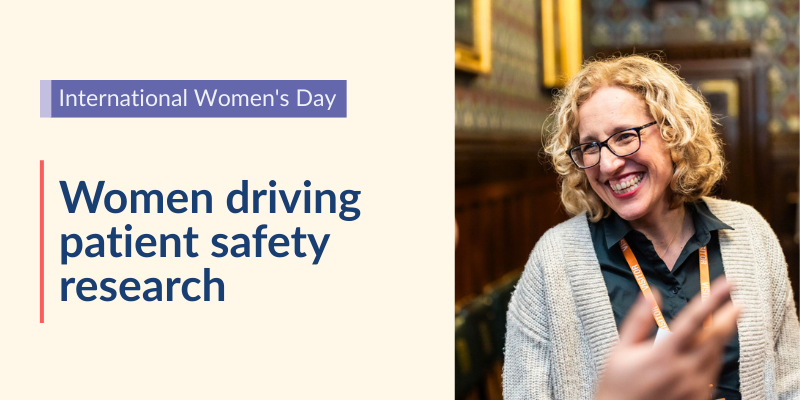
Women Driving Patient Safety Research: Meet Joy Spiliopoulos
On International Women’s Day 2026, we are celebrating the women who are driving innovation and shaping the future of patient safety research across our team. Their expertise, leadership, and lived experience are helping to transform how we understand risk, deliver safer care, and ensure that patient voices are meaningfully embedded in research.
We are delighted to spotlight one of our research associates, Dr Joy Spiliopoulos, working across our Enhancing Cultures of Safety research theme. Joy is a sociologist and qualitative researcher at the University of Leicester, and her particular expertise is migration, especially the migration of healthcare workers.
Read more about Joy below.

Meet Joy Spiliopoulos
Sociologist and qualitative researcher at the University of Leicester
1 – Tell us a bit about yourself and your research background.
My name is Joy Spiliopoulos, I’m half English and half Greek, and I’m a sociologist and qualitative researcher. I am also a trained social worker and former care worker. I hold a PhD from the Department of Applied Social Science (now Department of Sociology), Lancaster University. My particular expertise is migration, especially the migration of healthcare workers, and I use feminist theories in my work, primarily intersectionality.
I joined the SAPPHIRE research group, Department of Population Health Sciences, University of Leicester, UK, in June 2023. As a Research Associate, I am working as part of the team of the Enhancing Cultures of Safety research theme at the NIHR Greater Manchester PSRC.
I have worked for academic institutions in the UK (Lancaster University, University of Leicester and Sheffield College) and China (University of Nottingham Ningbo China, and Zhejiang University) and taught in the subject areas of sociology, international relations, criminology, gender studies, qualitative research methods. I am a Fellow of the Higher Education Academy (FHEA).
I have worked on a number of collaborative research projects funded by NGOs and government bodies (NIHR, ESRC, DFID, Oxfam, UK Home Office, local authority funded projects). I recently completed two funded projects on the effects of ‘Brexit’ on the retention and recruitment of migrant NHS nurses; and on returnee Filipino nurses. The collaborative project she led, ‘Retention and recruitment of migrant nurses post-Brexit’, has received international media attention, including television and radio interviews, and features in television, newspaper, think tanks and internet blogs in the USA, China, Singapore, the UK and other European countries, also from bodies such as the Royal College of Nursing (Nursing Standard journal), and others.
2 – What inspires you in your role, and who has influenced your journey in research or healthcare?
The topics of identity and belonging are very close to my heart, because of my own mixed cultural background and my own question of where I belong. Certainly my mother, a retired English teacher, has been a huge inspiration for me, encouraging me not only to read all the time but also to be passionate about human rights.
My interest in healthcare workers’ lived experiences started when I undertook my undergraduate dissertation on the topic of burnout affecting Greek social workers in governmental and non-governmental organisations. Also, my final two placements were at the Neurological clinic of the University of Athens and the Older adult team at the Lancaster Royal Infirmary. When I first arrived at Lancaster to do my PhD studies, I worked part-time as a care worker for Lancashire County Council and worked alongside a number of health and allied health professionals. Before undertaking my PhD research into the experiences of rural migrant care workers, I also did research work on public health and policy, specifically on the provision of local authority community services for a very diverse ethnically population in Lancashire. My doctoral research (using ethnography and interviews) in exploring the lived experiences of migrant workers in the care sector for older adults brought all of my interests together – care giving, older adults, migration of healthcare workers.
Throughout my career, I have had many female role models who have and continue to inspire me, such as my Greek social work tutors and supervisors, my PhD supervisor, directors of research centres, line managers, who have allowed me to grow as a researcher and a person. It would be remise of me not to mention Prof Carolyn Tarrant and Prof Nicola Mackintosh, who continue to encourage me to develop my skills and who inspire me to do my best.
3 – What are you currently working on and how does your work contribute to improving patient safety?
I am currently working on the National Evaluation of the Oliver McGowan Mandatory training (OMMT) with a team of researchers based at the University of Leicester, primarily, also with collaborators from Newcastle University and with the support of Inspired Purpose consultancy. This project focuses on how embedded this training is, its strengths and how it could be improved to create positive changes to how autistic people and people with a learning disability are supported by health and social care services.
4 – From your experience, what strengths or perspectives do women bring to patient‑safety research that enhance its quality or relevance?
I believe that in order to tackle health inequalities we need different perspectives, approaches and ideas and as many voices as possible to be represented in all aspects of research – from conception, to design, to data collection and analysis, to influencing policy and practice. I bring my own perspectives, experiences and passion to the work I do, especially in terms of equity of access to healthcare and to rights such as labour rights, secure and safe working conditions, inclusion and fostering belonging for migrant healthcare workers. I work with many diasporic nursing communities which allow me to learn and reflect, also to be inspired by the advocacy work that they do in supporting migrant nurses’ rights and to help them flourish. As a feminist, qualitative researcher and a queer woman I believe that women from different backgrounds and ethnicities can bring about change by uncovering injustices and health inequalities and advocating for a better future for all.
Women driving patient safety research
The views expressed are those of the author(s) and not necessarily those of the NIHR or the Department of Health and Social Care.
Related
[related-posts-thumbnails]



The University of Manchester
Oxford Rd
Manchester
M13 9PL
UK
Site hosted by The University of Manchester.
0 Comments