
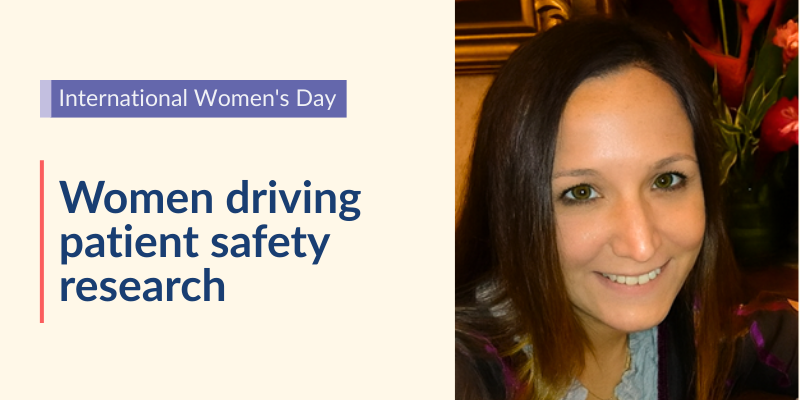
Women Driving Patient Safety Research: Meet Gill Lever
On International Women’s Day 2026, we are celebrating the women who are driving innovation and shaping the future of patient safety research across our team. Their expertise, leadership, and lived experience are helping to transform how we understand risk, deliver safer care, and ensure that patient voices are meaningfully embedded in research.
We are delighted to spotlight one of our funded PhD students, Gill Lever, who is working on a project exploring social workers’ implementation of national guidelines with looked-after-children who self-harm.
Read Gill’s story below.

Meet Gill Lever
PhD student in Health Psychology at the University of Manchester and NIHR Greater Manchester PSRC
- Tell us a bit about yourself and your research background.
I’m a PhD student researching how social workers implement NICE guidelines on self-harm with children in care. I came into research with direct lived experience of self-harm in state care and the cumulative harm of poor care continuity and inconsistent and insensitive approaches that erode patient trust. My background has shaped how I approach research: with a strong commitment to making sure that research is trauma-informed and that the people most affected by decisions have a voice in shaping them. This identity sits at the heart of my research journey. It keeps me grounded, reminds me of who I’m doing this for and why it matters.
- What inspires you in your role, and who has influenced your journey in research or healthcare?
A huge source of inspiration for me is my co-supervisor Dawn Dowding, Professor in Clinical Decision Making and Head of Nursing, Midwifery and Social Care at the University of Manchester. Dawn leads the Digital Health theme in the NIHR ARC Greater Manchester and has been extensively involved in the development and use of digital technologies in healthcare settings. She demonstrates that research isn’t just about generating knowledge; it’s about improving lives, supporting practitioners with the tools they need to make systems safer and accessible. Patient safety is fundamentally about understanding how humans behave in complex systems. Understanding the relational and structural dimensions of clinician decision-making helps to design practical interventions with scalable implementation. Dawn models values-driven leadership, intersecting compassion, efficiency and professional empowerment with responsible innovation in digitisation. She creates safe spaces for early‑career researchers to ask questions, challenge assumptions, and grow.
- What are you currently working on and how does your work contribute to improving patient safety?
I’m currently working on co-designing a behaviour‑change intervention to support social workers to implement NICE guidelines on self-harm with children in care. This involves mapping the barriers and enablers to safe, supportive practice and co‑producing intervention components with practitioners and young people with lived experience of self-harm in care to ensure interventions fit the realities of frontline practice. The combination of my research and lived experience has taught me that improving patient safety isn’t just about implementing frameworks or interventions; it’s about actively listening to patients and carers, being responsive to the realities of practitioners’ working on the frontline and designing systems for change that are implementable in practice. My work contributes to improving the consistency and quality of responses to self-harm, reducing risk through better decision‑making and communication, supporting practitioners to feel more confident and capable, and ensuring children in care receive safer and more compassionate support for self-harm.
- From your experience, what strengths or perspectives do women bring to patient safety research that enhance its quality or relevance?
Patient safety research often requires naming uncomfortable truths: unsafe staffing, toxic working cultures and discriminatory practices, or the emotional toll of care work. Women frequently lead this work because they understand, often from lived experience of normalised harms and system failures, how trust is built or broken during moments of acute vulnerability, and how organisational cultures can silence, shame, or retraumatise people seeking help. This instinct strengthens methodological integrity and ethical relevance and helps shift the focus of patient safety beyond checklists towards an understanding of how people actually experience care, and what compassionate care looks like in practice. As patient safety research increasingly grapples with inequalities, women’s involvement helps to ensure that safety initiatives do not inadvertently replicate the very harms they aim to prevent. This is especially important in an area where patient safety failures have tragic human consequences.
Women driving patient safety research

The views expressed are those of the author(s) and not necessarily those of the NIHR or the Department of Health and Social Care.
Related
[related-posts-thumbnails]



The University of Manchester
Oxford Rd
Manchester
M13 9PL
UK
Site hosted by The University of Manchester.
0 Comments