

Learning from Oslo: Reflections from the International Forum on Quality and Safety in Healthcare
By James Tawse | He/him | PhD Student | NIHR Greater Manchester Patient Safety Research Collaboration | NIHR School for Primary Care Research
In March 2026, I had the opportunity to attend the International Forum on Quality and Safety in Healthcare in Oslo as a final-year PhD student at the University of Manchester. My research focuses on patient safety, staff wellbeing, and support for healthcare professionals following patient safety events, so the forum offered a valuable opportunity to learn from international experts and share ideas with others working in this space.
It felt as though Norwegians were riding a wave of national pride during the conference. The country had recently topped the medal table at the Winter Olympics, was ranked number one in Europe for patient safety in a study by researchers at Imperial College London and the NIHR North West London PSRC, and football club FK Bodø/Glimt were enjoying an impressive run in the Champions League. The people were warm and welcoming, Oslo was beautiful and incredibly well organised, and it was easy to see why Norway consistently ranks among the happiest countries in the world.

Oslo, Norway
Day one of the conference opened with an emotional keynote from Kirsti Skogsholm, a mother who tragically lost her twin girls to suicide. Her experiences of being blamed and inadequately supported were a stark reminder of the importance of compassionate engagement with patients and families. She highlighted the impact of not being listened to, the importance of continuity of care, and the challenges created by a lack of collaboration between healthcare services.
The rest of the day was filled with fascinating talks. Highlights included sessions on using data to improve services, systems approaches to transforming patient safety, and a particularly interesting talk from researchers in the Netherlands, Norway and Denmark about supporting practitioners involved in adverse events.
Day two continued with a keynote talk from Michelle van Tongerloo, a GP and street doctor working in Rotterdam. She described her work advocating for people experiencing homelessness and the challenges of navigating systems that deny basic healthcare to those without a fixed address and documentation. Her talk was both inspiring and confronting. Other highlights included sessions on compassionate leadership and the role of football organisations in promoting population health- an area that I would love to explore further.
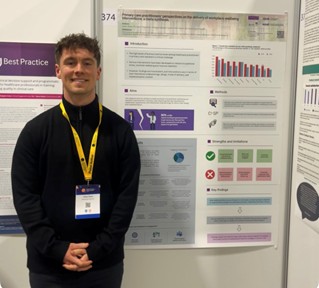
James Tawse with his poster at the International Forum for Quality and Safety in Healthcare 2026
Throughout the conference, I had the opportunity to meet fantastic researchers and share ideas around patient safety and healthcare staff wellbeing. I presented a poster displaying findings from our meta-synthesis study, which explored primary care professionals’ experiences of wellbeing and retention interventions. The study synthesised qualitative evidence on how these interventions are experienced by staff, highlighting the importance of supportive organisational cultures and meaningful engagement with healthcare professionals.
Attending my first international conference was an unforgettable experience. I am deeply grateful to my funders, the NIHR School for Primary Care Research and the NIHR Greater Manchester Patient Safety Research Collaboration, for making this opportunity possible. In today’s rapidly evolving healthcare landscape, shaped by shifting population needs, political pressures, technological advances, and workforce challenges, research on quality and patient safety is more important than ever!
James Tawse is a final-year PhD student at The University of Manchester, co-funded by the NIHR Greater Manchester Patient Safety Research Collaboration and the NIHR School for Primary Care Research. His project focuses on patient safety, burnout and primary care practitioners.
Supervisors: Prof Maria Panagioti, Dr Alex Hodkinson, Prof Chris Armitage, Prof Carolyn Chew Graham
Research theme
James’ study is supported through our Developing Safer Health and Care Systems research theme.
Related
[related-posts-thumbnails]



The University of Manchester
Oxford Rd
Manchester
M13 9PL
UK
Site hosted by The University of Manchester.
0 Comments