

Reasonable Adjustments Across the Learning Disability Annual Health Check Pathway
Research theme
Developing safer health and care systems
What was the research project about?
This project looked at how people with a learning disability, and the health and care professionals who support them, experience reasonable adjustments during annual health checks, and identifying ways to improve how these checks are delivered in practice.
Who did we work with on this project?
We worked closely with a Community Advisory Group of people with lived experience, and with Pathways Associates and People First North West, community organisations who helped design the study, recruit participants, and shape the findings. We also spoke with health and social care professionals working in the North West of England.
What did we do?
We ran six workshops, five with people with a learning disability and one with health professionals, plus two individual interviews with health professionals, between August and October 2024. These took place in familiar community settings or online. We asked people about their experiences of annual health checks, from getting the invitation letter through to booking, attending the appointment, and any follow-up, and what helped or made things harder. We then looked closely at everything people told us to find common patterns and themes.
What did we find?
43 people with a learning disability and 8 health professionals took part. We found that reasonable adjustments were shaped by three connected things:
- Personal: whether people were spoken to directly, given information in a format they could understand, and saw a familiar professional.
- Professional: whether staff felt confident and knew how to adapt care to someone’s needs.
- Organisational: whether the systems around booking, registers, and follow-up actually supported access.
When any of these broke down, adjustments tended to happen only after a problem came up, rather than being planned for in advance. When needs were identified and recorded early, health checks worked much better.
What are the key recommendations for health and care providers?
- Keep learning disability registers accurate and up to date, so no one is missed.
- Support continuity of care so people can see familiar staff.
- Record and act on individual communication needs in advance, not just on the day.
- Make booking and contact routes flexible (for example, offering different ways to get in touch).
- Have proactive follow-up systems for people who miss or cancel appointments.
- Speak to people directly, using their preferred way of communicating.

Project outputs
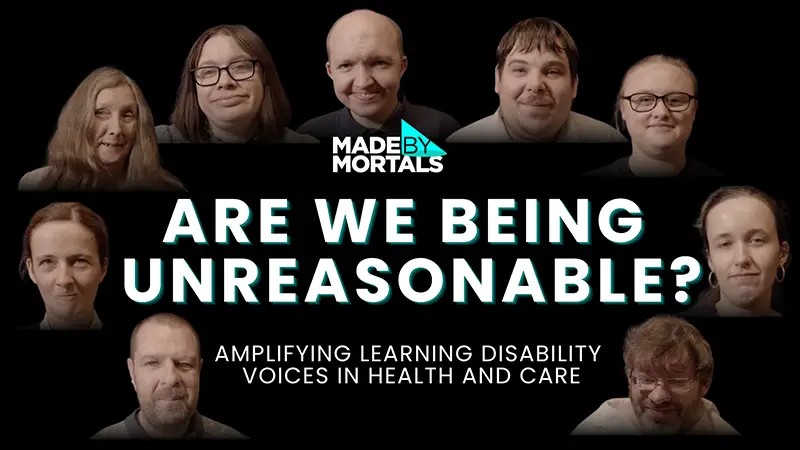
Are We Being Unreasonable?
With Made By Mortals, a creative arts organisation, we produced a short film co-created with people with learning disabilities, exploring reasonable adjustments and what inclusive primary care can look like.
Through lived experience and shared insights, the film highlights some of the barriers people with learning disabilities can face when accessing primary healthcare, and the changes that can make a real difference.
The film offers practical reflections on how healthcare professionals and services can better understand and respond to individual needs, helping to create more accessible, inclusive and person-centred care.
It was made in collaboration with BLOOM at LEAP and Bury People First.
Made by Mortals Resource pack
Who was part of the research team?
| Name | Affiliation |
| Nicola Ditzel | School of Medicine and Dentistry, University of Lancashire, Preston, UK |
| Dr Kelly Howells | NIHR Greater Manchester Patient Safety Research Collaboration (GM PSRC), University of Manchester |
| Dr Louise Gorman | NIHR Greater Manchester Patient Safety Research Collaboration (GM PSRC), University of Manchester |
| Dr Tom Blakeman | NIHR Greater Manchester Patient Safety Research Collaboration (GM PSRC), University of Manchester |
| Stephanie Gillibrand | University of Manchester (Williamson Building, Oxford Road, Manchester) |
| Professor Caroline Sanders | NIHR Greater Manchester Patient Safety Research Collaboration (GM PSRC), University of Manchester |
| Professor Umesh Chauhan | School of Medicine, University of Lancashire, Preston, UK |
Behind the screen
Exploring virtual wards through diverse perspectives



The University of Manchester
Oxford Rd
Manchester
M13 9PL
UK
Site hosted by The University of Manchester.