
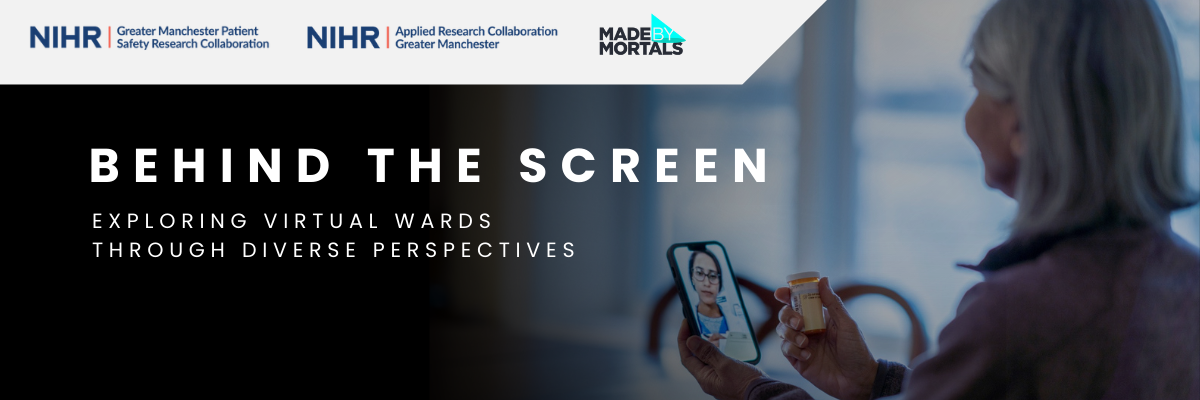
Behind the screen: Exploring Virtual Wards Through Diverse Perspectives
Virtual wards, also known as Hospital at Home, are changing the way care is delivered across the NHS, offering hospital‑level support to patients in the comfort of their own homes. Instead of being admitted to hospital, or after being discharged early, some patients now have the option to receive remote monitoring through technology and treatment where they feel safest.
NHS Integrated Care Systems have been funded to extend virtual ward provision, and the NHS is increasingly implementing virtual wards to support people in the place they call home, including care homes. However, a rapid evidence synthesis (RES) published in Age & Ageing, indicated that there is limited evidence of clinical effectiveness of Virtual Wards.
Investigating the effectiveness of this service is therefore crucial to understand how virtual wards are actually working, and to explore whether there are any differences in experiences and patient safety impacts associated with varied models of service delivery for people with frailty. To address this need, the NIHR Greater Manchester Patient Safety Research Collaboration (GM PSRC) and the NIHR Applied Research Collaboration, Greater Manchester (ARC‑GM) are undertaking an independent evaluation of the virtual wards service being implemented across Greater Manchester, aiming to understand how virtual wards are organised and delivered across the region.
To understand the real‑world impact of this model of care, we needed to hear directly from the people and communities who might use it.
Therefore, to explore how virtual wards are being understood and experienced across the Greater Manchester region, we engaged with four distinct community groups to explore their thoughts and experiences around virtual wards and hospital-at-home care:
- Polish-speaking older adults
- Older members of the Chinese community
- South Asian women of mixed ages,
- A walking football older men’s group (predominantly white British)
Each discussion provided deep insight into cultural beliefs, healthcare expectations, and the challenges of implementing new models of care in different communities.
We worked in collaboration with community connectors to plan recruit facilitate and organise appropriate translation and refreshments for the discussion groups.
This blog focuses on the Patient and Community Involvement and Engagement outputs of this research project. Further findings, publications and additional outputs from the study will be available soon.
Creating Space for Open Dialogue
With Made By Mortals, a creative arts organisation, we coproduced an interactive approach to the group discussions utilising the participatory arts approach. We utilised a pre-existing resource of an imaginary couple, Ruby & Dennis, who were navigating the health service to set the scene of the hospital at home scenario.
 In order to gain valuable insight from the four community groups, we delivered an
interactive workshop. To begin the workshop, and to move participants to respond with
their hearts as well as their minds, we shared one of Ruby & Dennis audio stories with them. The piece is a love story about a couple who renew their connection amidst illness. The story centres on Ruby, who lives with dementia, and her husband, Dennis, her primary carer.
We also played a video that explained what a virtual ward was, which you can watch below. As the video was in English, each groups translator had received the script beforehand so could live voice over in the retrospective languages (Polish, Cantonese and Urdu).
Voices from the Community: Insights on Virtual Wards
After listening to the audio story extracts, participants from the four community groups discussed their thoughts on virtual wards, highlighting the cultural factors that may influence how healthcare is accessed and experienced.
The discussions were framed around three key questions:
- If somebody from your community was placed on a virtual ward like Ruby, how might they feel?
- What could be the challenges and barriers for a member of your community to accessing healthcare via a virtual ward?
- How can healthcare professionals best support people in your community accessing healthcare on a virtual ward?
Explore their perspectives, edited into three short insight audio packages, by clicking on the play buttons below.
Group discussion 1:
If somebody from your community was placed on a virtual ward like Ruby, how might they feel?
Group discussion 2:
What could be the challenges and barriers for a member of your community to accessing healthcare via a virtual ward?
Group discussion 3:
How can healthcare professionals best support people in your community accessing healthcare on a virtual ward?
Capturing Voices for Change
We recorded these conversations as audio reflections, ensuring that policymakers and decision-makers can hear the voices of those directly impacted by healthcare changes. These personal narratives provide a nuanced understanding of how different communities perceive virtual wards and hospital-at-home models, offering valuable insights that go beyond statistics and data.
Language, culture, and lived experiences shaped the way people viewed virtual care. By creating a welcoming environment and facilitating discussions in culturally appropriate ways, we ensured that voices that are often underrepresented in policy discussions were heard.
Polish-Speaking Adults:
This group reflected on their experiences navigating the UK healthcare system, often comparing it with healthcare in Poland. Trust in digital healthcare services was a key theme—some participants expressed concerns about language barriers in remote consultations, while others saw virtual care as a practical solution for accessing healthcare without long waits.
Men’s Walking football over 60:
The were mixed feelings about digital technology and the concept of “hospital at home.” On one hand, some appreciate the convenience and comfort of receiving care in familiar surroundings, avoiding the stress and disorientation of hospital stays. However, others felt uncertain and even intimidated by the reliance on digital devices and remote monitoring, especially those that lack confidence with newer technologies. Concerns about privacy, reliability, and a perceived loss of personal interaction with healthcare professionals were also arise. While some might embrace the autonomy it offers, others felt overwhelmed or excluded, highlighting the importance of support, clear communication, and tailored digital literacy training to make these services truly accessible and reassuring for older adults.
Older Chinese Community:
For this group, traditional values around family involvement in care played a significant role in shaping views on virtual wards. While some saw hospital-at-home care as a way to stay close to family, others were concerned about whether it would provide the same level of reassurance and expertise as an in-person hospital stay. There was also concerns that the traditional Chinese home is no longer as supportive and multi generational for everyone to get this level of support and presumptions should not be made. Digital literacy also emerged as a discussion point, with some expressing hesitancy about navigating online health platforms.
South Asian Women (Mixed Age Group):
This discussion was rich with intergenerational perspectives. Younger women were generally more open to the idea of virtual care, especially as a way to reduce hospital visits for elderly relatives, whereas older participants expressed concerns about the lack of face-to-face interaction with doctors. Cultural expectations around care, particularly the role of family members in managing health, also shaped the discussion. There were also strong opinions about the culture and family environment not being assumed by decision makers.
Key Learnings
- Trust and Accessibility: While some participants saw benefits in virtual healthcare, many emphasised the importance of trust in the system. Language barriers, digital literacy, and past experiences with healthcare influenced their comfort levels with virtual wards.
- Cultural Considerations Matter: Each group brought unique cultural perspectives on care, highlighting the need for flexible and culturally competent approaches when implementing virtual care.
- Family and Community Support: Many participants viewed healthcare as a collective experience, where family involvement should always be considered but to be careful of assumptions.
Moving Forward
This work reaffirmed the importance of community engagement in shaping healthcare policies. By actively listening and valuing lived experiences, we can co-develop solutions that work for everyone. We need to continue conversations about equitable and inclusive healthcare design, ensuring that virtual wards and hospital-at-home services are implemented in ways that truly meet the needs of diverse communities.
The insights from these discussions are valuable for more than those working in virtual care at home and speak to digital health care of the future.
This blog focuses on the Patient and Community Involvement and Engagement outputs of a joint NIHR GM PSRC and NIHR ARC-GM research project on virtual wards. Further findings, publications and additional outputs from the study will be available soon.
Acknowledgements
This work has been funded by the National Institute for Health and Care Research (NIHR) Greater Manchester Patient Safety Research Collaboration (GM PSRC) and NIHR Applied Research Collaboration, Greater Manchester (ARC-GM).
The Ruby and Dennis audio story was originally co-produced with individuals living with dementia, in collaboration with Dementia United. Listen to the full audio story here.
Behind the screen
Exploring virtual wards through diverse perspectives
NIHR ARC-GM
NIHR GM PSRC
Related
[related-posts-thumbnails]Behind the screen



The University of Manchester
Oxford Rd
Manchester
M13 9PL
UK
Site hosted by The University of Manchester.
0 Comments