
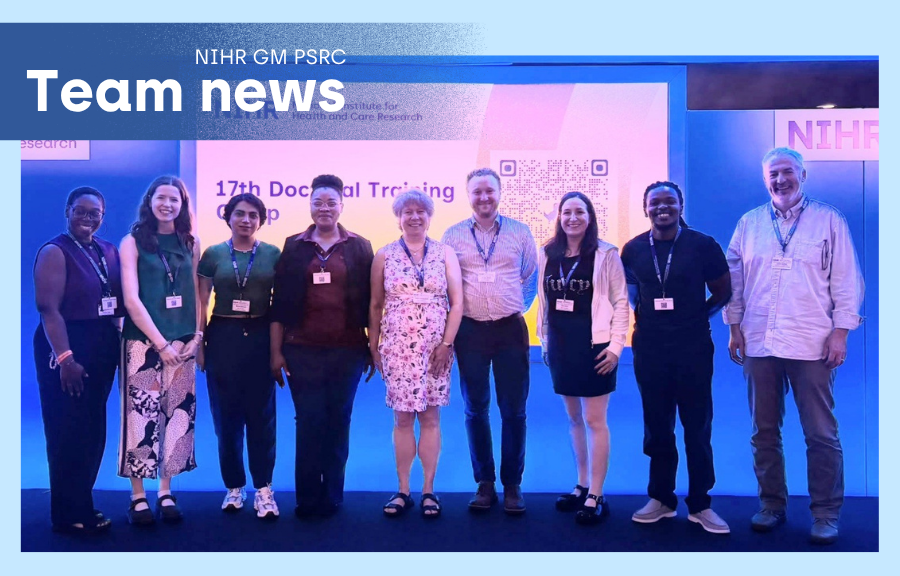
GM PSRC PhD Student wins award for Best Public and Patient Involvement at NIHR Doctoral Training Camp
Our funded PhD student, Gill Lever, has brought home an award from the National Institute for Health and Care Research (NIHR) Doctoral Training Camp, recognising an outstanding example of patient and public involvement embedded in research.
Gill, a PhD student at The University of Manchester, attended the 17th NIHR Doctoral Training Camp, held from 7 to 9 July. This annual face to face event provides training and practical experience on how to put together a successful funding application.
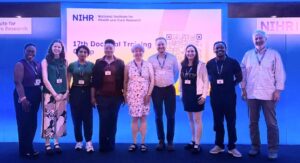
GRT HELP group receiving the award at the NIHR Doctoral Training Camp
During the intensive three-day programme, participants were given 24 hours to work in groups to design and submit a mock full grant proposal for £500,000. Gill and eight other researchers formed a working group called GRT HELP, rose to the challenge, and were awarded Best Public and Patient Involvement across all proposals developed by participants at the training camp.
In April, Gill was also awarded the Best PPIE Embedded Within a Project Award at the NIHR SafetyNet PhD Event 2026, which recognised her PhD research, “Social workers’ implementation of national guidelines with looked-after children who self-harm.”
At the NIHR Greater Manchester PSRC, we are proud to congratulate Gill on the outstanding quality of her work and her commitment to excellent PPIE practice.
Read more below in Gill’s own word about her experience at the NIHR Doctoral Training Camp:
“Diversity is being invited to the party” (Verna Myers) and Patient and Public Involvement is codesigning the playlist, the dancefloor, the tempo and sensory experience to be safe and culturally alive for everyone who steps, rocks or rolls in.
What happens when a multidisciplinary, multi-ethnic, multi-neurotype team are serendipitously thrust together at the NIHR Seventeenth Doctoral Training Camp with 24 hours’ notice to produce a competitive funding bid, aligned with Fit for the Future?
Strangers became friends, lived experience and public contribution took central stage and we birthed GRT HELP (Gypsy, Roma and Traveller Heart Equity Local Partnerships). And then we performed Gangnam style to scoop the award for best PPIE!
We asked:
- Who feels welcome to enter?
- Who feels safe to stay?
- Who gets to influence the vibe?
- Who can move freely without fear of judgement?
- Whose rhythms are centred, not merely tolerated?
And when we couldn’t answer “everyone”, we adapted our methodology, pace, and expectations.
In Gypsy, Roma and Traveller (GRT) communities, dance traditions carry histories of resilience, celebration, and cultural pride. A trauma‑informed approach means recognising that not everyone arrives at the party with the same experiences of safety or belonging. GRT communities have been systematically excluded from too many rooms. Many of us have learned that stepping forward is too risky.
Public involvement shouldn’t feel like an audition. It should feel like a celebration of lived experience – a space where people bring their own steps, their own histories, and their own cultural rhythms, and those contributions shape the whole event. It’s recognising that some people dance quietly at the edges, some prefer a slower beat, and some need clear signals before stepping in. We don’t drag anyone onto the dancefloor- we offer choice, control, and consent at every step. We honour stims, spins, scripted performances and silence because every rhythm is valid.
It’s about research being done with and by people with lived experience, not to or for them. This means Patient and Public Contributors aren’t just being invited to attend the party – they are the life and soul of it!
By Gill Lever, PhD student at The University of Manchester, funded by the NIHR Greater Manchester Patient Safety Research Collaboration (GM PSRC)
Research Theme
Gill Lever is supported through our Preventing Suicide and Self-Harm research theme.
Related
[related-posts-thumbnails]



The University of Manchester
Oxford Rd
Manchester
M13 9PL
UK
Site hosted by The University of Manchester.
0 Comments