
From hospital to community: what helps people with mental health conditions manage medicines safely?
Being discharged from a mental health hospital can be a challenging and disruptive time for many patients and their support networks. In the transition from hospital back to the community, patients may experience changes to their medicines, delays or difficulties in getting prescriptions, or a lack of medication reviews post discharge. These challenges can lead to further changes to medicines, the need for additional care, readmission to hospital and, in some cases, medication-related harm.
However, medication safety after discharge from a mental health hospital depends on more than prescriptions and the medicines themselves. Researchers from The University of Manchester found that preventing medication-related harm also relies on the support networks patients have, their relationships with healthcare professionals and the circumstances of their everyday lives.
The study, funded by the National Institute for Health and Care Research (NIHR) School for Primary Care Research (SPCR) and the NIHR Patient Safety Research Collaboration (PSRC): Greater Manchester, aimed to understand how people with mental health conditions managed their medicines after leaving hospital, and how family, friends, carers and healthcare professionals helped them during the transition from hospital to the community.
Findings highlight that patients and carers often undertake considerable work to ensure medicines are available and taken safely. When communication between services is poor or support is lacking, this responsibility can become overwhelming and potentially put patients at risk.
Recognising medication management as a shared responsibility, improving communication and providing personalised support could help make the transition from hospital to community care safer and more manageable.
How was the research carried out?
 This study builds on previous research by the late, and much missed, Sudeh Cheraghi-Sohi, who previously identified different types of ‘medication work’ , the routine tasks and strategies people use to manage their medicines safely. This includes making sure they take the right medicines at the right time and dose, how they access and understand information about their medicines, and how much they feel confident and reassured about taking them.
The researchers then aimed to explore how these medication-related tasks rely on patient’s social networks of support. Support networks are the connections between people that are important in helping them manage their health. This support can reduce isolation, help people access information and supporting them in taking their medicines safely.
What did the researchers do?
The researchers interviewed 34 people in the UK:
- 10 people with lived experience of mental illness who had been discharged from hospital.
- 7 carers who supported someone with mental health difficulties.
- 17 healthcare professionals, including doctors, nurses and pharmacists working in the community or involved in discharge from hospital.
Participants talked about their experiences of managing medicines after they had left hospital, the challenges they faced and the support they received. During the interviews, researchers worked with the participants to create ‘social network’ diagrams identifying the people and organisations they relied on for support.
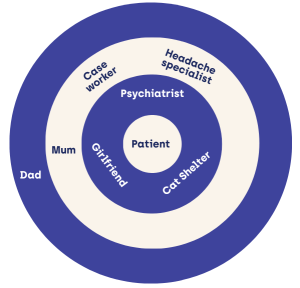
Example of a ‘social network’ diagram created with one of the study’s participant
Example of a ‘social network’ diagram created with one of the study’s participant
What did the study find?
Participants described the medication-related tasks and strategies needed to stay safe in the community after leaving a mental health hospital. These included:
- Making sure they had the right medicines by getting their prescriptions and collecting their medicines on time
- Ensuring their medicines were taken in the best way for their health
- Having strategies for organising the practical work of taking medicines daily, such as buying dosette boxes, creating routines and fitting medicine-taking into daily life.
The study also found that patients often faced challenges with taking and managing their medicines, such as dealing with different healthcare professionals and experiencing stigma. Support networks could play a crucial role in helping them manage these challenges. Family and friends provided emotional support, while peers and voluntary organisations offered shared understanding and practical advice. Healthcare professionals provided clinical advice, information and support with medication safety. However, each person’s support network differed in its size, who was part of it and the type of support it provided.
The researchers also identified a new type of medication work, which they called ‘situated medication work’. This describes how the work people do to stay safe with their medicines is shaped by their everyday social and cultural circumstances.
What does this mean for mental health care support in the community?
The findings suggest that managing medicines after hospital discharge should be treated as a shared responsibility rather than something patients are expected to manage alone. Medication management is a shared process involving patients, carers and wider support networks.
It is important to recognise that discharge planning does not happen only at the moment someone leaves hospital. Support should reflect people’s needs and circumstances as they move back into the community.
Using network diagrams at discharge could help identify the support available to people to manage their medicines in the community and tailor discharge plans to individual needs. For people with limited support networks in particular, having support from healthcare professionals in the community is important. This could include clear communication, a named healthcare professional, and clarity about who will support patients with their medicines and how.

Paper title: Medicines, ‘medication work’ and networks of support in the community following mental health hospital discharge: A qualitative interview study
Authors: Mark Jeffries, Fiona Naylor, Natasha Tyler, Catherine Robinson, Maria Panagioti and Richard N. Keers
Published in Social Science & Medicine at https://doi.org/10.1016/j.socscimed.2026.119910.
Related
[related-posts-thumbnails]



The University of Manchester
Oxford Rd
Manchester
M13 9PL
UK
Site hosted by The University of Manchester.
0 Comments